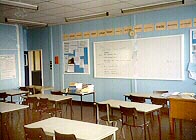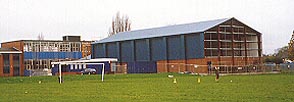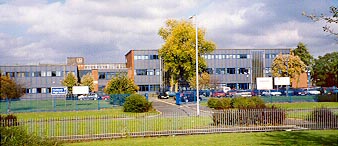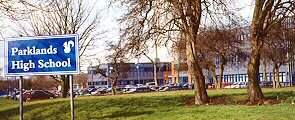
Poundswick today |
|
Poundswick is now called Parklands High School; somebody must have thought it was a good idea. |
| Presumably no-one would contemplate
changing the name of Eton or Harrow to
"Parklands". To do it to Poundswick is, in my
view, no less an act of vandalism. However, the
unchangeable fact is that the school was built at a place
which has been called Poundswick for nearly 800
years. Whatever they choose to call the school, it will
always belong to Poundswick; it will always be Poundswick's
High School. The change of name seems to have come about in rather bizarre circumstances. There had, apparently, been a proposal that South Manchester High School should be absorbed by Poundswick some years before, but friends in high places managed to secure a stay of execution for South Manchester. When closure could no longer be resisted, the "friends" pushed for amalgamation rather than absorbtion, proposing that a completely "new" school should be formed. A competition was held to decide a new name and Parkview was the winner, a suggestion presumably based on the small park opposite Poundswick on the other side of Simonsway. In the event, the competition result was ignored and the new administration unilaterally decided that the "new" school should be called Parklands. So much for 800 years of history. If you drive past the school today, it looks very different from the Poundswick of the 50s or 60s or even of the 80s, but the differences are actually not as great as they look. Most of the "old" school remains, refurbished and modernised of course, but still very recognisable, inside and out. The major changes are, in fact additions, and in the main these have been carried out tastefully and to a constructional standard at least as good as the original. |
| On Monday 9th July 2001 I visited Parklands and took photographs which have enabled me to compile Poundswick today. I am indebted to Parklands' Headteacher, Mr. M. H. Buczynski, for allowing me to do this and to the Deputy Head, Mr. M. A. Murray, who kindly gave myself and Bill Nicholson (who taught at Poundswick from 1957 to 1982) three hours of his time showing us round and answering our many questions. | 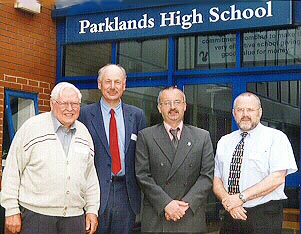 © Wythenshawe World |
| Pictured in this photo are, left to right: Bill Nicholson, Jim Cook, Mike Buczynski, Mike Murray. |
| Once through the main door you inevitably head for the hall, which is little changed from the early days. O.K., the bamboo has gone, as have the swinging bamboo partitions between the hall and the dining room; these have been replaced by a solid wall. The wooden "sounding boards" with their integral loudspeakers are as shiny as ever and underneath the carpet tiles lurks the original brown-and-yellow squared floor. | 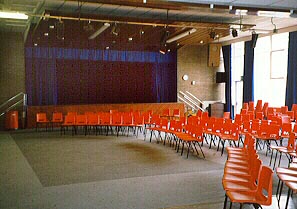 |
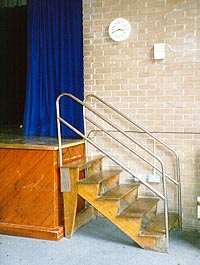 |
No, your eyes are not deceiving you. These really are the original 1956-vintage stairs up to the stage. How many thousands of feet have clambered up them over the years? Accompanied usually by churning stomachs prior to reading the lesson at Morning Assembly, receiving a book at a prizegiving ceremony, singing in a school concert or performing in a play. What tales these stairs could tell if they could speak! |
| Here's a view you probably won't recognise. "That's not Poundswick", I can hear you say. Well, yes it is, taken from roughly where the statue used to be. It's a view of the new English, Maths and I.T. teaching block at the back of the school. | 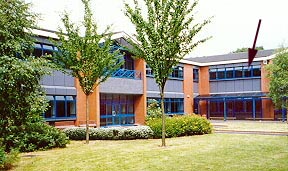 |
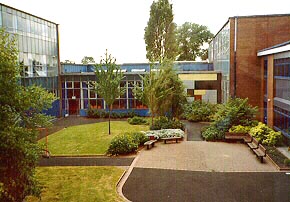 |
This photo will give you an idea of how it all goes together. It was taken from the arrowed window in the photo above. Building the new block has enabled a quiet, peaceful and very attractive enclosed garden to be created. All it needs now is a statue and a pool to really set it off. |
| Here's a view of the dining room, which was greatly extended from the original when Parklands was opened. I took this photo with my back to where the old swinging partitions used to be. The original outside glass wall ran along the line of the two white pillars and I estimate that the extension has at least doubled the available dining area. | 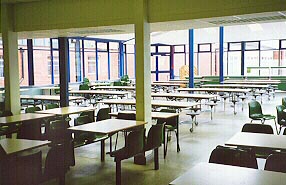 |
| This, together with cafeteria service, has enabled the lunch break to be reduced to 45 minutes by eliminating the need for a "second sitting". The kitchen and serving hatch are still in their original places, beyond the right-hand edge of this photo. |
| The first major addition to the school was built in the early seventies when the school leaving age was raised to 16. This single-storey, pitched-roofed annexe lies to the west of the science block and is reached from it by a long corridor. In its early years it was used as a sixth-form centre and it is now used for teaching music and arts. | 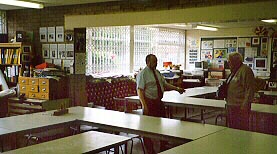 Inside the Music and Arts Centre. |
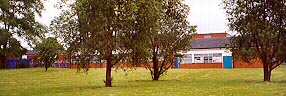 |
A leafy view of the Music
and Arts Centre |
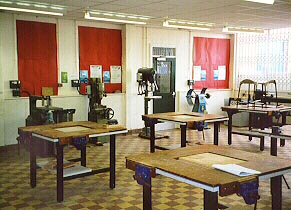 |
Wandering round the outside of the school, you'd be forgiven for concluding that the old Woodwork and Metalwork shops had been demolished and built over. In fact they have merely been extended and re-covered with a pitched roof. |
| The original floor gives this this location away; it's Mr. Stansfield's Woodwork shop, although I hate to think what he'd make of these flimsy benches compared with his beautiful, solid originals, each with its own set of immaculate woodworking tools. There is now no distinct boundary between woodwork and metalwork, the emphasis being on design and construction, with computers in use to help with design. A far cry from chiselling out slots in the "boat" and making a nail box and a towel rail. Happy days! |
 |
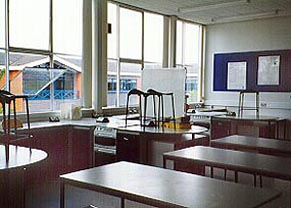 |
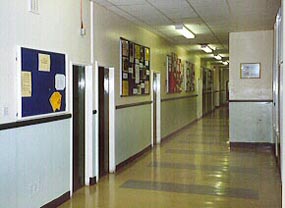
| A Poundswickian of the 60s wouldn't
get lost walking round the main teaching block today.
It's been modernised and refurbished but its layout is
essentially the same, the immediately obvious difference
being the removal of the alcoves of cloak pegs and shoe
racks (I never thought to ask where Parklandians keep
their coats). It all looks bright and cheerful and well
looked-after. The views above are of the ground-floor
corridor, with the staff room on the left and one of the
very-well-refurbished domestic science rooms on the first
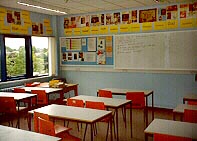
floor. Here are some more Main Block views that you might remember: |
|
Room12 Room 17 |
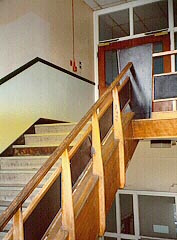 The
Main Block East Staircase |
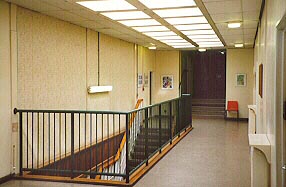 |
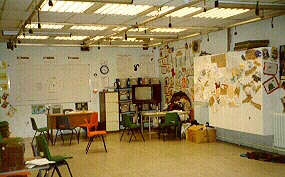 |
| Above left: The top of the
"staff only" stairs, with the Deputy Head's
office on the right (this was originally Miss Champness's
office) and the Small Hall on the left. Above right: Inside the Small Hall. This was originally Mr. J. F. Scarth's Geography room. Right: The Library. |
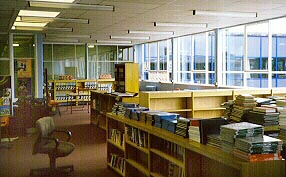 |
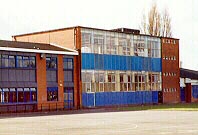 |
From the rear, the Gym Block looks rather old and battered. Unlike previously, the school grounds are no longer secure; the general public has access to the whole of the outside of the building and the paths are used as shortcuts by local shoppers and others with perhaps less innocent intent. |
| Blue glass has been replaced with stout blue plywood and clear glass with more durable perspex in an attempt to beat the vandals. Inside, the lower (formerly boys') gym is now used as a general P.E. and games area but the upper (girls') gym, pictured here, is in lovely near-original condition with its beams, ropes and wallbars still in good working order. The changing rooms and their access stairs are also little different from the 1950s. | 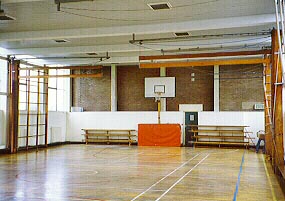 |
| The Science Block has also not changed greatly. Again, the coat racks have gone which makes the landings appear much more airy. This photo shows the first-floor landing with one of the labs beyond the door with the window in it. The right-hand green door used to be the prefects' room with a Lab Tech's prep room (which still exists) behind it. | 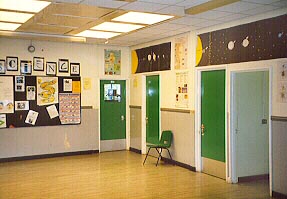 |
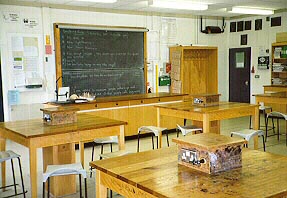 |
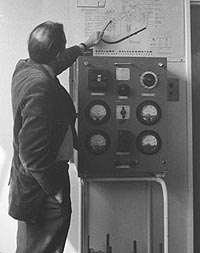
Students of "O" and "A" level Physics in the sixties will immediately recognise this as Mr. T. Owen's Physics Lab; somehow his presence still echoes round the place. The dip circles and tangent galvanometers have gone, as has the power supply console to the left of the blackboard. Even so, you couldn't mistake it, could you? |
| Well, blow me down! I
happen to mention Mr. Owen and the power supply console and, in true Poundswick fashion, it isn't long before someone comes up with a picture of both of them! Anyone got a picture of a dip circle or a tangent galvanometer? |
 |
| Recent developments at
Parklands include the re-instatement (after an absence of
19 years) of its sixth form. This has been achieved in
partnership with the Manchester College of Arts and
Technology. I hope that Poundswick's new sixth formers
not only enjoy their stay but also feel encouraged to give
something to the place by way of mentoring younger
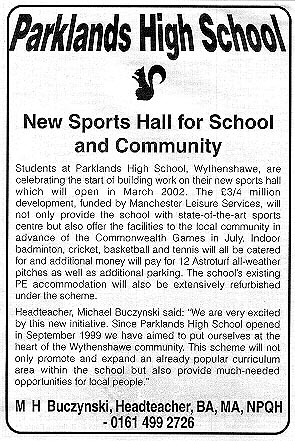
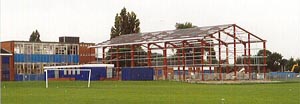
pupils and, most of all, by setting them a good example. Another development is the new sports centre which is intended to benefit both the school and the local community. Building work started in the summer of 2001 and the Wythenshawe World of 20th July carried this announcement about it. |
 |
 |
|
Two
views of the new Sports Centre under construction during
the Autumn of 2001. |
|
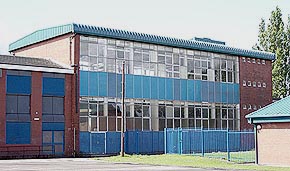 |
Floyd Adu has been busy with his digital camera again and sent us this photo of the gym block with its new "hat", which was fitted during the spring of 2002. Dinky, isn't it? Should keep the rain out for another 30 years, with luck. |
Over the decades, Poundswick's fortunes have ebbed and flowed. Towards the end it suffered badly from under-funding but the savings resulting from the closure of South Manchester High School together with extra cash from the government's Excellence in Cities initiative have enabled this to be addressed and the school's fortunes now look brighter. There is obvious determination and drive to make Parklands a better school. A recent Ofsted report stated that "Excellent leadership and strong staff commitment combine to make this a very effective school giving good value for money". The new administration has been charged with the duty and honour of bearing the Poundswick torch; I'm sure all Old Poundswickians wish it every success. |
|
|